
Are you building a product or building a business?
AI and no-code tools have made building easier than ever. Which is mostly brilliant - but it can create a particular trap.
When building is frictionless, building itself becomes ‘the thing’. Features get added, the product starts to look real and momentum builds. And somewhere along the way an important question gets deferred.
Is this actually a business?
These are the questions worth sitting with before you build anything else.
Who is this really for?
Not a user type. A specific person — someone you can picture — at a specific moment.
What has just happened in their life that makes them reach for something like this? What have they already tried? What would make them say "this is exactly what I needed, right now"?
If you can't picture that moment clearly, you don't have a customer yet. You have an assumption.
What are they doing instead?
Forget who else is building something similar. What is your customer doing today to solve this problem - if they’re a small business, maybe it’s a spreadsheet and WhatsApp. Maybe it’s some generic software that they’ve made work, and just got used to. Or maybe it’s nothing at all?
That's your real competition. And the question isn't whether your product is better than a rival, but whether it's worth the friction of changing a habit.
That's a different bar. Worth knowing clearly.
If the features were identical, why would they choose you?
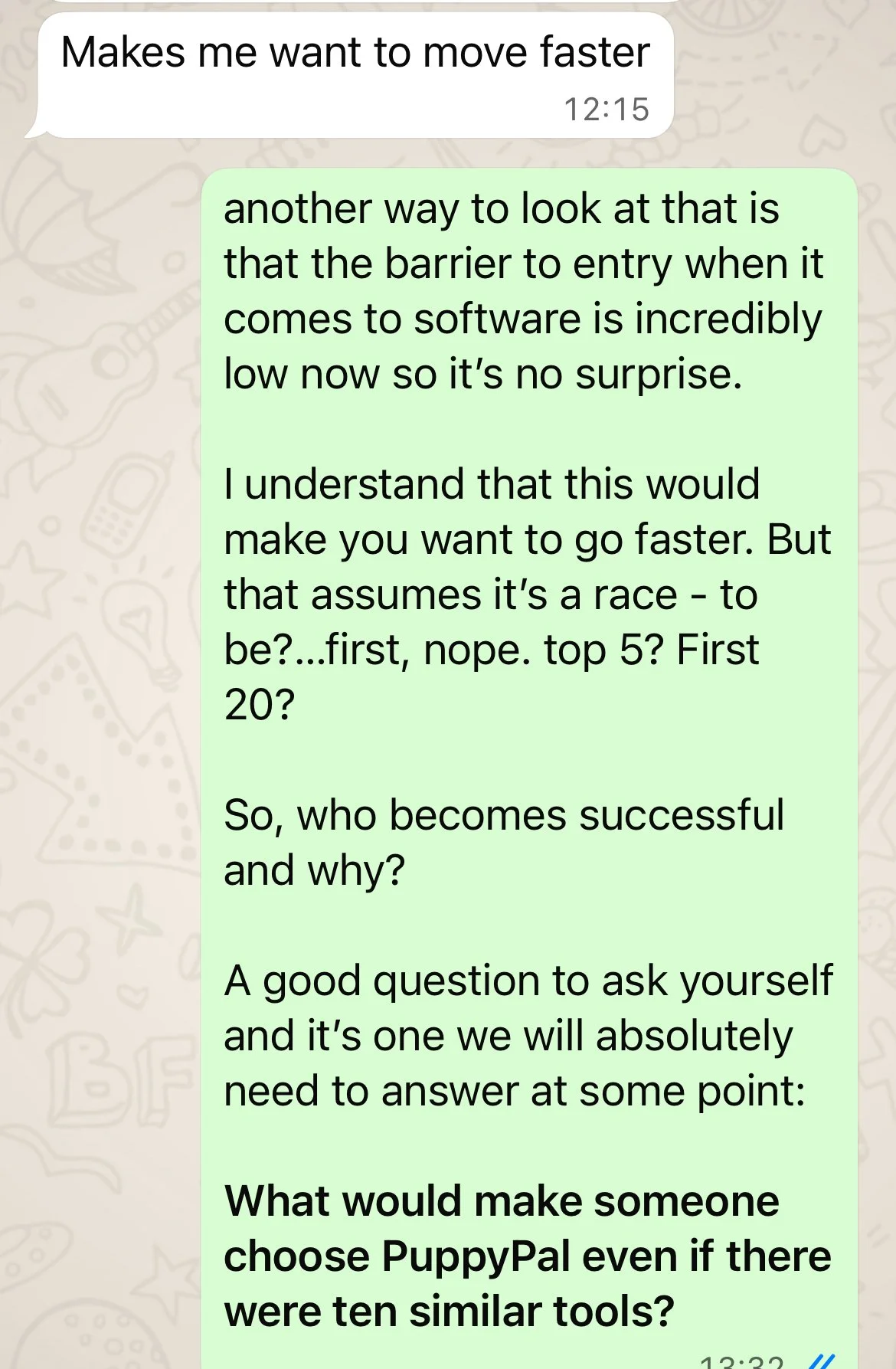
Real client chat!
Here’s a snippet from real conversation I had with a Founder who had gone deep into building features in Lovable and then noticed that someone else appeared to already have launched something similar.
The truth is that any feature you build can eventually be copied, now…maybe even in minutes. So if someone compared you to your nearest competitor — same functionality, similar price…what would make them choose you?
The answer is usually something like trust, proximity, shared values, a point of view. Things that are genuinely hard to replicate. But most builders never surface this, because they're deep in the product rather than thinking about the positioning.
No amount of additional features fixes a positioning problem.
What were you originally trying to solve?
Before the build got underway, there was probably a clearer sense of why this mattered - a problem you'd seen, a gap you'd noticed, a community you wanted to serve.
Is that still what you're building toward? Or has the product drifted somewhere else while you weren't looking?
That's what had happened to Craig at PuppyPal. He'd started out with a clear mission - a platform for responsible dog owners and local vendors - and had drifted into building what was starting to look like a B2B SaaS CRM. Not through any bad decision, just through the accumulated weight of small ones. And those decisions that were proving hard to actually make.
When we worked through it together, the answer wasn't to build differently. We felt there was a need to refocus on the things that had made the idea worth building in the first place - being ‘hyper local’, community driven, high quality content, genuine partnerships with people who cared about the same things. The stuff that software doesn't deliver, and can't easily be copied.
That's a very different venture to the one he'd been heads-down building. And let’s face it, a much stronger one.
A note on these questions
You may have noticed that none of them are about the product. They're about the venture - the why, the who, the what that sits underneath the build.
Now you could put them into ChatGPT and get answers back. And they'd probably sound reasonable. But let’s face it they wouldn't push back when your answer was a bit ‘meh’, or notice that you'd skipped the hard one, or spot the gap between what you're saying and what you actually mean.
That's the thing about being too close to it - you don't always know which question you're avoiding.
The work I do with founders in The Next Move is a focused conversation that helps you step back, see the whole thing clearly again, and decide what actually deserves your attention next. It is not a framework or a workshop. Just sharp thinking (which I visualise and map), with someone genuinely invested in helping you find the answer.
If any of this feels familiar, it might be worth a conversation.